B2 · 5 dk okuma · 604 kelime ·
Storks Between Two Continents
İki Kıta Arasında Leylekler
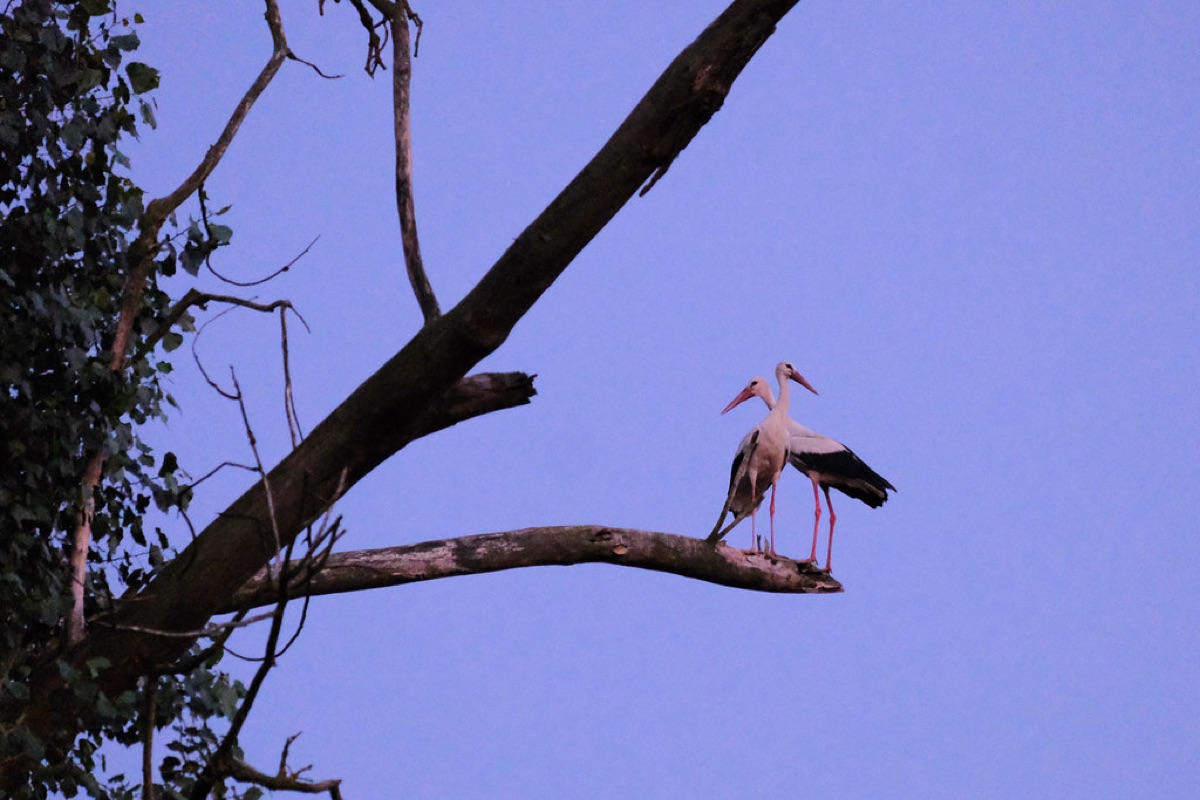
Görsel: jurek d. (Jerzy Durczak) (CC0), flickr
önce İngilizcesini oku
Every year, at the end of summer, people in Istanbul who happen to look up at the sky may witness one of the most impressive journeys in the natural world.
Huge flocks of white storks, sometimes thousands of birds at once, circle slowly above the Bosphorus before heading south.
They are on their way from Europe to Africa, and Istanbul, standing between two continents, is one of the most important points on their route.
Storks are large birds, with wings that can measure about two meters from tip to tip, and flapping those wings for thousands of kilometers would use far too much energy.
Instead, they rely on thermals, columns of warm air that rise from the ground as the sun heats it.
A stork enters a thermal, circles upward with its wings held still, and then glides for kilometers toward the next thermal, slowly losing height like a paper airplane.
Storks usually fly during the warmest hours of the day, when thermals are strongest, and spend the night resting in trees or on open fields.
This way of flying is remarkably efficient, but it has one serious limitation.
Thermals hardly ever form over the sea, because water warms up much more slowly than land.
For this reason, storks avoid crossing open water and choose routes where the sea is as narrow as possible.
The birds that breed in western Europe fly over the Strait of Gibraltar, where Spain and Morocco are only 14 kilometers apart, while those from central and eastern Europe follow the eastern route through Istanbul.
At the Bosphorus, the gap between Europe and Asia is less than a kilometer at its narrowest point, so the crossing takes only a few minutes.
From there, the storks continue over Anatolia, the Middle East and Egypt, and many of them spend the winter in eastern or southern Africa, more than 10,000 kilometers from their nests.
Every fall, volunteers count the passing birds from the hills on the Asian side of the city, and on a good afternoon they can see thousands of storks, along with eagles and other birds of prey that use the same route.
Scientists have learned a great deal about these journeys by attaching small GPS trackers to storks.
The data shows that a stork can cover several hundred kilometers on a good day.
It also shows that young birds, which make the journey for the first time without their parents, find the route mostly by instinct and by following other storks.
The trackers have also shown how dangerous the journey can be, because many young storks do not survive their first year, often because of storms, power lines or a lack of food.
Although the journey is long and dangerous, some storks are now changing their habits, and a growing number spend the winter in southern Spain, feeding at landfills instead of flying all the way to Africa.
Storks have long been part of Turkish culture.
Because adult storks have almost no voice, they communicate by clattering their beaks, a sound that also gave them one of their Turkish folk names, "hacılaklak."
In many villages, people are happy when a stork builds its nest on their roof, and some pairs return to the same nest year after year, repairing and enlarging it until it weighs hundreds of kilograms.
In some places, people even put up special platforms on tall poles to give the birds a safe place to build their nests.
So the next time you see a flock of storks circling over the city, remember that they may be at the start of a journey of more than 10,000 kilometers.
Arkadaşınla paylaş
Bu yazıdaki gramer
Metinde gördüğün yapıları ücretsiz derslerle öğren.
Ücretsiz test
İngilizce seviyeni 5 dakikada öğren
Ücretsiz gramer testi: hangi derslerden başlaman gerektiğini söyler.
Testi çöz